

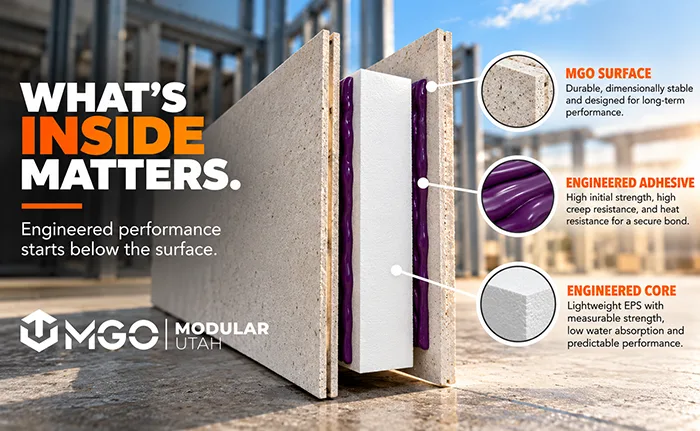
When most people look at a wall, they see the finished surface. What they don’t see is the combination of materials, bonding methods, and engineered components working together underneath.
That distinction matters. Modern wall systems aren’t simply about replacing one traditional building material with another. They’re about designing an assembly in which the individual components work together to provide consistent, predictable performance.
At MGO Modular, that thinking extends beyond what you see on the outside of the panel. The materials inside the system—and the way those materials are brought together—are an important part of the story.
It Starts With the Core
One of the advantages of engineered construction is the ability to select materials based on measurable properties rather than simply relying on convention.
The engineered expanded polystyrene (EPS) core represented in the system’s technical documentation is a good example. The documented Geofoam material is manufactured in multiple ASTM D6817 types, with different densities and corresponding levels of compressive resistance.
In other words, this isn’t simply generic foam filling empty space. It is an engineered material with defined physical characteristics.
Technical documentation for the Geofoam describes it as a lightweight engineered material with physical strength and predictable dimensional properties. The data also addresses water absorption, flexural strength, elastic modulus, and surface-burning characteristics.
For an engineered wall system, that predictability matters. The goal is to understand how the materials within an assembly are expected to behave rather than leaving performance entirely to variables encountered on the jobsite.
The Bond Matters Too
A panel is only as useful as the way its components work together.
That’s why the engineered adhesive used during manufacturing isn’t an afterthought. The engineered polyurethane adhesive documented for the system’s lamination process is designed for applications requiring high initial strength, high creep resistance, heat resistance, and sufficient open time during manufacturing.
Those details aren’t something a building owner is likely to see once a wall is installed. But they’re a good illustration of what engineered manufacturing is really about.
Every layer has a job to do.
The MGO surface matters. The engineered adhesive matters. The lightweight engineered core matters. And ultimately, the way those components work together as an integrated system matters.
Engineered Rather Than Improvised
Traditional construction requires many individual materials and processes to come together at the jobsite. Quality can depend on sequencing, weather, material handling, installation conditions, and the availability and experience of the crews performing the work.
An engineered wall system approaches the problem differently.
More of the assembly can be planned and controlled before it reaches the jobsite. Materials can be selected for specific characteristics, components can be manufactured consistently, and the finished panel arrives as a more integrated building component.
That doesn’t eliminate the need for proper design or installation. What it does is move more of the process toward repeatability and control.
And in construction, reducing unnecessary variables can have real value.
Lightweight Can Still Be Engineered for Performance
There’s sometimes an assumption that heavier automatically means stronger or better.
Modern engineered materials demonstrate why that isn’t necessarily the case.
The Geofoam technical data, for example, identifies several different material grades, with minimum densities ranging from 0.70 to 2.85 pounds per cubic foot and corresponding minimum compressive resistance at 1% strain ranging from 2.2 to 18.6 psi.
The important point isn’t that every project needs the highest number. It’s that an engineered material can be selected according to the requirements of the application.
That’s a fundamentally different way of thinking about building materials: use the properties you need, where you need them, as part of a designed system.
Look Beyond the Surface
The most visible part of a building isn’t necessarily where the most interesting engineering is happening.
Behind a finished wall can be a carefully considered combination of surfaces, core materials, bonding technologies, manufacturing processes, and structural design. Each component contributes something different to the complete assembly.
That’s part of the thinking behind the MGO Engineered Wall System.
Rather than looking at a wall as a collection of individual materials assembled one piece at a time, MGO Modular approaches it as an integrated system. The MGO surface, engineered adhesive, lightweight engineered core, and manufacturing process each have a job to do—working together to support strength, efficiency, and consistent real-world performance.
Because when it comes to building better, what’s inside matters.
Learn more about the MGO Engineered Wall System and how engineered construction can change the way your next project comes together.
